
Practise the Setup, Move and Exit of Every Pass
Use five structured karting passing drills to practise setup, inside control, abort decisions, switchbacks and clean exits without relying on contact.
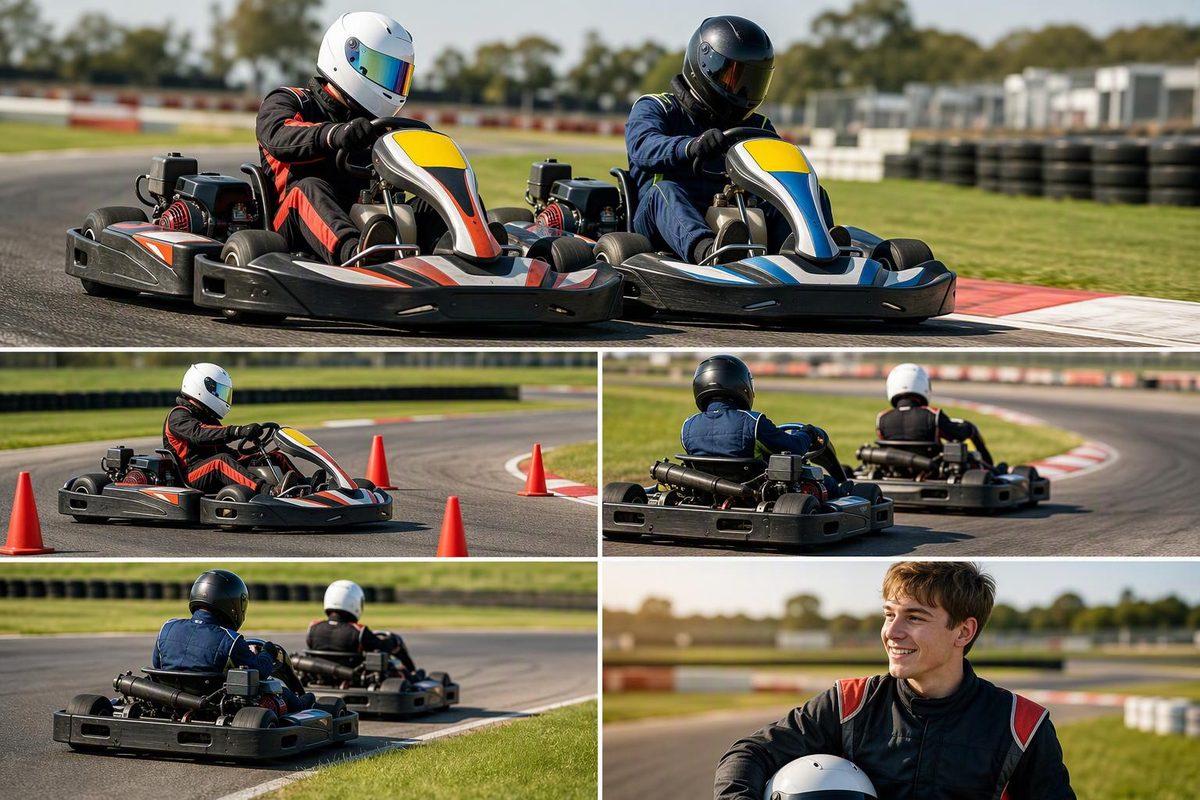
A clean karting pass has three parts: create the opportunity, place the kart alongside under control, then preserve the position without contact or a vulnerable exit. The five passing drills below isolate observation, inside-line control, commitment, switchbacks and the next-corner exit so you can practise each part deliberately.
Record the outcome of each attempt; the scorecard totals clean passes, sound decisions and failures.
Ten-Attempt Passing Scorecard
Choose the outcome after each complete pass-and-next-corner sequence.
| Try | Outcome | Pts |
|---|---|---|
| 1 | — | |
| 2 | — | |
| 3 | — | |
| 4 | — | |
| 5 | — | |
| 6 | — | |
| 7 | — | |
| 8 | — | |
| 9 | — | |
| 10 | — |
Scoring: clean pass retained through the next corner = 2; clean abort or side-by-side exit without a completed pass = 1; contact, track-limits breach, late reaction or forcing a driver off = 0.
Source: Passing-drill scoring rubric in this article. Apply the circuit or organiser’s rules when judging each attempt.
Run these drills only in an organised session where the circuit or coach explicitly permits paired practice. Attend the briefing, obey every flag and apply the venue’s rules rather than assumptions taken from television or another championship.
For example, Daytona’s 2026 InKart rules prohibit overtaking under yellow flags and penalise a position gained through contact. Its overlap and space criteria are specific to that series, so they should not be treated as universal karting rules (Daytona Motorsport).
Choose One Suitable Passing Corner
Use a corner with:
- a straight approach long enough to establish position;
- a clear braking reference;
- enough width for two karts where the venue permits it;
- a useful exit, ideally leading onto another straight;
- good visibility and no blind incident area.
A slow hairpin after a straight is usually more useful than a fast bend. At PFi, elite kart driver Joe Turney identifies the first hairpin as the circuit’s best overtaking opportunity, while stressing the need to watch the exit when braking late (Motorsport UK). The braking zone creates the opening, but the exit determines whether the pass lasts.
Pair drivers of reasonably similar pace and alternate attacker and defender every two or three attempts. Before adding another kart, establish your solo braking, turn-in, apex and exit references using the method in Kart Racing Lines, Explained.
Agree on the drill, pace and stopping procedure before leaving the pits. The defender should know whether to hold a normal line, maintain an outside lane or take the prescribed defensive entry. Surprise is useful in racing, not while establishing a controlled exercise.
Drill 1: Follow Without Passing
Purpose: Learn to observe rather than attack as soon as a gap appears.
Follow the other driver for three laps without attempting a pass. Stay close enough to study their line but far enough back that you never need their rear bumper to slow your kart.
On each lap, examine one cue:
- Where do they begin braking?
- Do they turn in early, normally or late?
- Do they miss the apex or slide beyond it?
- How soon do they return to the throttle?
- Where does their kart arrive at corner exit?
After three laps, describe one specific opportunity: “They brake early into the hairpin,” or “They run wide and delay the throttle.” “I felt faster” does not identify where or how a move can be built.
Checkpoint: You can identify the same weakness on two laps without making contact or compromising your own line.
This is the setup phase of overtaking. KartClass similarly advises learning an opponent’s weak sections and considering what follows the passing corner, because a poor exit can expose the attacker to an immediate switchback (KartClass).
Drill 2: Hold the Inside-Line Exit
Purpose: Control the tighter line instead of arriving too fast to use it.
Begin with the attacker positioned on the inside before the normal braking point. The defender holds the outside lane and leaves room. Run below full race pace initially.
The attacker should:
- Brake in a straight line.
- Be prepared to brake earlier than on the normal racing line.
- Turn towards a later, tighter apex.
- Reduce speed enough to hold the inside half of the exit.
- Accelerate only when the kart can leave the corner without drifting into the defender.
An inside line has a smaller corner radius and may provide less grip away from the rubbered racing line. KartClass therefore advises allowing for earlier braking and controlling apex speed rather than overshooting and surrendering the place on exit (KartClass).
Complete four clean repetitions with each driver as the attacker. Increase towards race pace only while both drivers remain predictable.
Checkpoint: Both karts clear the exit side by side, without contact, a track-limits breach or forced avoidance.
If the attacker repeatedly runs wide, move the braking reference earlier before changing anything else. The go-kart braking drill provides a structured way to stabilise that entry.
Drill 3: Decide to Commit or Abort
Purpose: Remove the dangerous half-commitment that leaves neither driver sure what will happen.
Agree on a visible decision marker before turn-in, such as a marshal post, painted line or permanent track feature. This is a practice cue, not a claim about who is entitled to the corner under race regulations.
Approach in line. The attacker may move inside, but at the marker must make one of two decisions:
- Commit: The kart is sufficiently alongside under the venue’s rules, the path is open and the attacker can stop on the inside line.
- Abort: Lift or brake, return behind without contact and prepare a better exit.
The defender drives one predictable line and does not react late. Repeat with deliberately varied gaps so the attacker practises rejecting poor openings as often as accepting good ones.
Checkpoint: Make five consecutive unambiguous decisions. A clean abort counts as success; forcing the other driver to evade does not.
Motorsport UK’s 2026 rules permit only one change of direction in response to an overtaking attempt and prohibit crowding another vehicle beyond the track edge or making abnormal direction changes (Motorsport UK). Those provisions do not replace your organiser’s rules, which remain the standard for your session.
Drill 4: Create a Switchback on Exit
Purpose: Pass on the exit when the inside entry is closed.
The defender deliberately takes a shallow, defensive entry. The attacker shows the kart but does not force it into a disappearing gap. Instead, the attacker should:
- Brake a fraction earlier.
- Stay wide enough to rotate behind the defender.
- Aim for a later apex.
- Straighten the steering sooner.
- Cross underneath only after the defender runs deep or wide.
Look through the corner towards the possible exit lane rather than at the defender’s rear bumper. If that lane never opens, remain behind.
The switchback depends on a speed and direction difference at exit. Diving towards the first patch of open tarmac too early usually tightens the line, delays acceleration and puts the attacker back near the defender’s rear bumper.
Checkpoint: The attacker draws alongside on exit while both drivers retain a usable lane. If the move requires a bump, it was not set up correctly.
Drill 5: Keep the Pass Through the Next Corner
Purpose: Retain the position rather than merely reaching the first apex ahead.
Start one corner before the selected passing zone and finish one corner after it. The attacker may use an inside pass or switchback. Once ahead, that driver must make one predictable positioning decision for the next corner while continuing to leave appropriate space.
Score each attempt using the scorecard above:
- 2 points: A clean pass is completed and retained through the next corner.
- 1 point: A clean, timely abort or side-by-side exit with no completed pass.
- 0 points: Contact, a track-limits breach, a late reaction or another driver being forced to leave the circuit.
Do not award a bonus for the latest braking point. Motorsport UK’s 2026 short-circuit kart regulations allow penalties when a driver gains an unfair advantage or disadvantages another competitor through their driving (Motorsport UK). A pass that depends on contact is not a successful repetition.
Measure Decisions as Well as Completed Passes
Record ten attempts and track clean completions, clean aborts and failed attempts. If timing is available, compare the time from the preceding corner’s exit to the following corner’s exit. That exposes a dramatic-looking pass that costs substantial race time across the complete sequence.
Change only one element per set: the decision marker, braking point or exit target. The deliberate process in Practice Makes Permanent helps separate a useful adjustment from random variation.
In rental karts, reassess brake response and acceleration whenever you change kart. Preserve the same observation and decision process instead of blindly reusing the same pedal inputs.
The target standard is an attacker who can explain the opening, make or abandon the move before turn-in becomes a crisis, hold a lane through the corner and preserve the exit. Those are repeatable passing skills, whether the next step is a rental league or a club grid.