
Practice Makes Permanent—So Make Every Lap Measurable
Turn “practice makes permanent” into a karting drill using fixed entry, apex and exit cues, one controlled change and lap-time checkpoints.
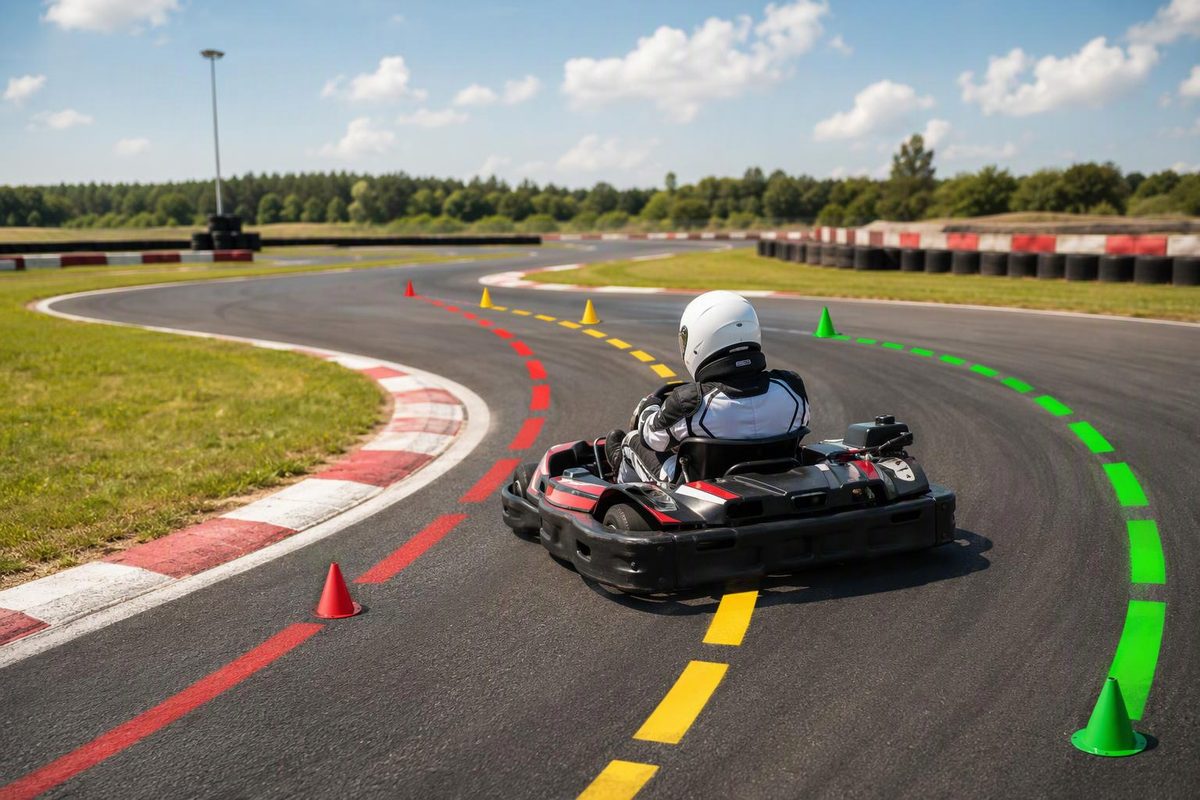
“Practice makes permanent” is useful coaching shorthand, not a literal law. If every lap has a different braking point, turn-in and exit, more laps can simply make that inconsistency familiar. Better practice gives each lap a defined task and uses the result to choose the next attempt.
That is consistent with the deliberate-practice framework described by Ericsson, Krampe and Tesch-Römer: improvement comes from effortful activities designed to improve performance, rather than experience alone (The Role of Deliberate Practice in the Acquisition of Expert Performance).
For a kart driver, one corner is a manageable task. Break it into three observable decisions:
- Entry: Where did braking start, and was the kart under control at turn-in?
- Line: Did the kart reach the intended apex—the point where it comes closest to the inside edge?
- Exit: When did the steering begin to open, and where did the kart arrive at the outside edge?
Do not try to change all three at once.
Set up a one-corner drill
Choose a straightforward corner leading onto a useful straight. Improving the exit gives you more time to observe the result before the next braking zone. If you first need to establish a basic route through the corner, start with this guide to kart racing lines.
Before driving, choose one visible reference for each phase:
- Braking reference: a marshal post, barrier joint, painted line or other fixed object beside the circuit.
- Apex reference: a specific section of kerb or track edge.
- Exit reference: the point where you expect to be opening the steering and allowing the kart to move outward.
Choose references that are fixed, distinct and visible at speed. Shadows, other karts and loose cones can move or disappear.
Motorsport UK’s driver guidance makes the same practical case for consistency: specific references let a driver fine-tune a line and use the lap timer to judge a change. Without repeatable laps, it is difficult to tell whether a time difference came from that change or from variation elsewhere (Motorsport UK).
Keep this as a driving test. In an owner kart, leave tyre pressures, gearing and chassis settings unchanged during the drill. In rentals, use the same kart and session where possible. Traffic, changing grip and differences between rental karts can mask a small improvement.
Run three practice blocks
1. Establish a repeatable baseline
Drive several clean laps at a pace that leaves enough attention to hit all three references. Do not move the braking point yet.
After the run, record:
- clean lap times, or sector times if available;
- how often you reached the planned apex;
- whether the steering was opening at the exit reference;
- the recurring miss, such as an early apex, delayed acceleration or running out of road.
Do not use your single fastest lap as the whole baseline. Compare a small group of representative clean laps. One exceptional lap can hide a process you cannot reproduce.
2. Change one decision
Choose the recurring miss that most clearly damages the corner, then make one modest change:
- Braking too late: move the braking reference earlier while leaving turn-in unchanged.
- Missing the inside: adjust turn-in without also changing braking and acceleration.
- Early apex and pinched exit: turn in slightly later and aim farther around the inside edge.
- Running wide with steering still wound on: reduce entry speed before trying to accelerate earlier.
- Slow exit despite reaching the apex: check whether you are waiting too long to open the steering and accelerate.
Hold that change for another short block of clean laps. The question is not, “Did one lap feel faster?” Ask, “Did this change repeatedly produce the intended entry, apex and exit?”
The fastest route through one corner is not always best for the lap. In a linked sequence, giving up speed in an earlier bend may improve the final exit onto the straight. Motorsport UK’s guidance likewise advises treating linked corners as a set and prioritising the last part of the sequence (Motorsport UK).
3. Keep, reject or reduce the change
Keep the change when:
- you can reproduce the new reference;
- the exit is cleaner, not merely more dramatic;
- representative lap or sector times improve without more invalid laps, spins or contact.
Reject it if repeated clean attempts do not improve the measured result. Reduce it if the direction appears useful but the adjustment was too large. Then repeat the cycle with one new variable.
Timing needs context. A quicker lap in clear air is not directly comparable with one spent passing traffic, and a slower lap does not automatically disprove the change if another part of the lap was compromised. Sector timing or video can help isolate the corner, but neither is required to begin.
Reset before the error becomes the drill
For this exercise, use two consecutive misses as a reset cue. Return to the last references you could reproduce and lower the entry demand enough to regain the intended apex and exit. Once the shape is stable, build pace again in small steps.
Use cues tied to visible outcomes: “brake at the barrier joint,” “reach this section of kerb” and “open the wheel toward that exit mark.” Those cues are easier to check than “be smoother” or “try harder.” If a coach or onboard video is available, review one narrow question after the run: Was my turn-in late enough to create the planned exit?
Fit the drill around the venue’s briefing, flags and driving rules. Never slow abruptly, stop on circuit or ignore nearby traffic to complete an exercise. Operator rules differ. K1 Speed, for example, describes its racing as non-contact and uses flags for cautions, stops, passing instructions and safety infractions (K1 Speed rules). Your circuit’s briefing and officials take priority.
Test whether the habit survives
At your next session, attempt the corner before studying all your previous notes. Can you recover the same braking, apex and exit references? Are several clean times comparable, allowing for traffic and conditions? If so, you have stronger evidence that you retained the process rather than merely finding a rhythm during one run.
Only then introduce variation, such as an alternative line for traffic or combining the corner with the next sequence. Random or interleaved practice is sometimes promoted as a way to improve retention, but its real-world advantage should not be overstated: a 2024 meta-analysis found a medium overall benefit for high-interference practice, while the benefit was almost negligible in applied settings (Więcek and colleagues, 2024). Use variation to test an established skill, not as a guaranteed shortcut.
The useful meaning of “practice makes permanent” is simple: do not just accumulate laps. Define the entry, apex and exit; change one decision; measure several clean attempts; and reset when the intended process disappears.