
Out-In-Out Is the Start, Not the Answer: Racing Lines From Geometry to Racecraft
The racing line explained from geometry up: entry wide, apex late-ish, exit wide — and why the fastest line through one corner is often wrong for the lap.
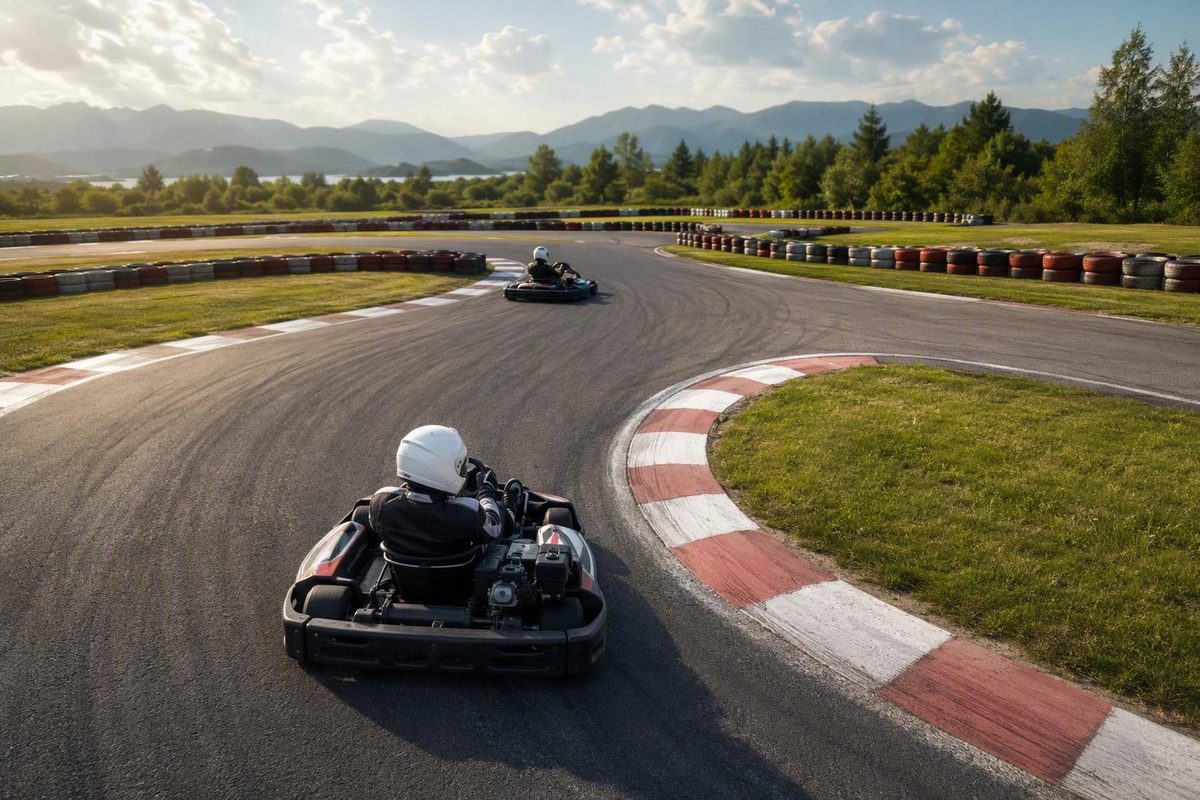
Every karting guide starts with “out-in-out,” and every fast driver eventually learns that it is only the first chapter. Here is the racing line explained from its geometry up — and the two reasons the textbook line is frequently the wrong one.
The geometry: why wide-apex-wide works
A kart corners fastest on the largest possible radius, because maximum cornering speed rises with radius. Entering wide, clipping the inside at the apex, and releasing wide on exit turns a tight corner into a gentler arc than the track’s painted edges suggest. That is the whole geometric argument: out-in-out is just radius maximization.
The correction: prioritize the exit
Pure geometry treats a corner in isolation. Real laps chain corners into straights, and time on a straight is earned at its first metre. So the practical rule is: the corner’s job is to launch the straight that follows. That means a slightly later apex than geometry alone suggests — sacrifice a little entry speed, get the kart rotated earlier, and be at full throttle before the apex is behind you. A classic mistake is carrying heroic entry speed, drifting wide mid-corner, and feeding throttle late; it feels fast and times slow.
Reading a corner’s priority
Not all corners deserve the same treatment:
- Corner onto a long straight: late apex, exit is everything.
- Corner at the end of a long straight: braking point matters more than line; attack entry.
- Linked corners: the last one before the straight wins; drive the earlier ones to set up the final exit — often on deliberately “wrong” lines.
- Kart-specific: karts have no differential, so a sharp initial turn-in that lifts the inside rear briefly helps rotation — smooth-but-decisive beats gentle.
Learning it deliberately
Walk or slow-lap the track and mark three points per corner: braking, apex, exit. Then move one variable at a time — apex five metres later, brake five metres deeper — and read the stopwatch, not the feeling. Consistency beats bravery: the driver who hits the same marks every lap can improve them; the driver who improvises cannot.
The racing line is not a secret; it is a discipline. Geometry gives you the shape, the exit rule gives you the priority, and the stopwatch settles every argument.