
How Tire Pressure Changes Go-Kart Handling—and How to Test It
Understand higher and lower kart tire pressures, cold versus hot readings, and a controlled test using corner-entry, apex and exit cues.
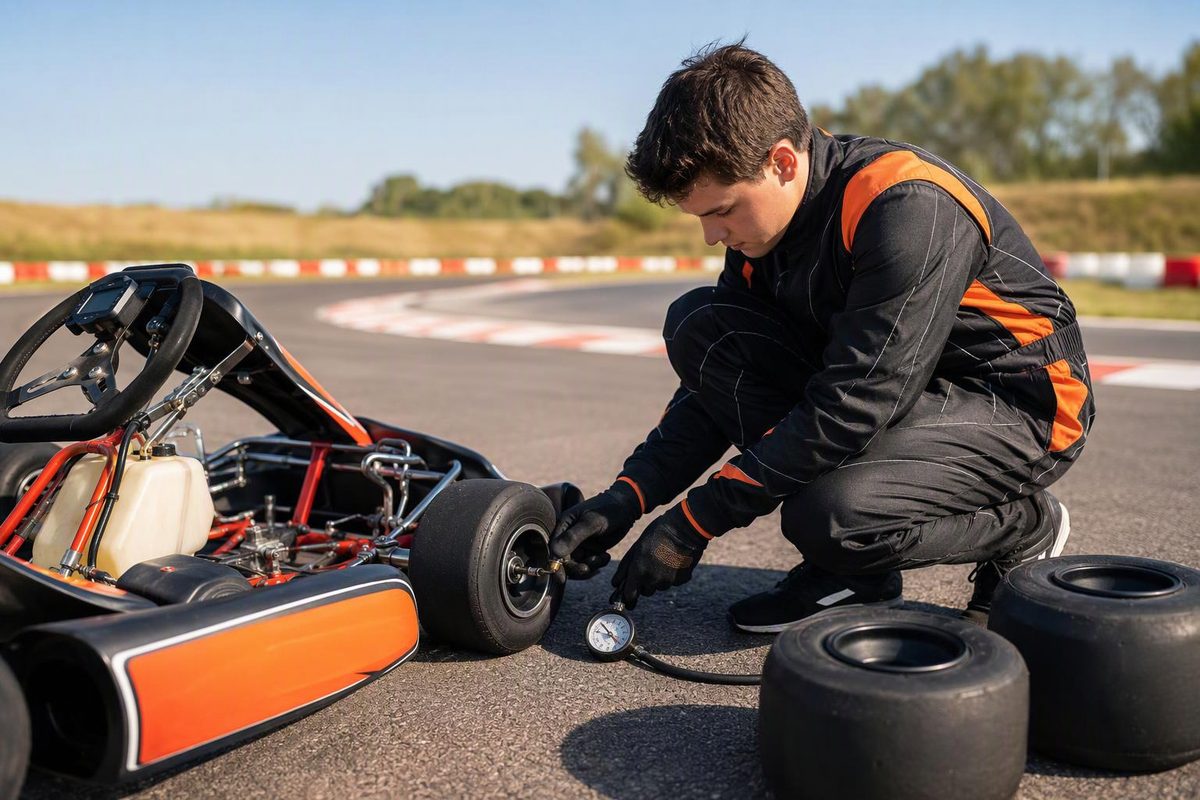
Tire pressure changes how a kart responds to steering, builds grip and holds that grip through a session. Higher pressure can help tires warm up sooner; lower pressure can help control temperature once conditions are hot or grippy. Neither automatically means more grip. The useful setting depends on the tire and the pressure it reaches on track, not just the number you set in the paddock. Top Kart USA explains why harder and softer compounds can need different approaches.
The tendencies below concern dry-track running on racing slicks, not a pressure prescription for rental or wet-weather tires. For rental drivers, leave adjustments to circuit staff unless they explicitly permit them. Your useful task is to describe where and when the handling changes. For owners, pressure is a setup variable to test—not a substitute for repeatable driving.
What higher and lower pressure can do
Pressure affects tire temperature and the kart’s balance. Racing Edge Motorsports describes higher front pressure as potentially giving a more responsive steering feel, while lower front pressure can feel more stable but take longer to warm up. Those are tendencies, not guaranteed fixes for understeer or oversteer. Its setup guide also stresses checking both feel and lap times.
The main trade-off is warm-up versus sustained performance:
| Change from a suitable baseline | Possible benefit | What to watch for |
|---|---|---|
| Slightly higher starting pressure | Earlier grip in cold or low-grip conditions | Grip fading later as temperature and pressure rise |
| Slightly lower starting pressure | Better temperature control in hot or high-grip conditions | Slow warm-up or tires that never begin working properly |
AMV Kart Components identifies lack of grip after several laps as a possible low-pressure symptom and overheating as a high-pressure problem. That is why “lower pressure gives more grip” is an incomplete rule: a tire below its working range can still slide.
Do not use a universal PSI recommendation. Tire model, compound, wheels, track conditions and driving style all affect the appropriate starting point. Use guidance for your actual tire and kart, rather than copying another class’s numbers. KartletiX’s pressure guide explains these variables.
Read the handling by corner phase
Pick one familiar corner and keep your braking point and line fixed. Record observable behavior rather than simply writing “more grip.”
- Entry: Does the kart respond to your first steering input, or do you add more lock while it runs wide? That wide-running behavior is understeer.
- Apex: Can you hold the intended line with steady steering, or does the kart slide, hop or need a correction?
- Exit: As you unwind the steering and apply throttle, does the rear remain settled or step outward? Rear sliding is oversteer.
Then note the lap on which each behavior appears. A kart that struggles initially but improves differs from one that starts well and fades.
These observations do not prove pressure is the cause. Before changing setup, check that your braking and steering inputs are repeatable. Use the repeatable cornering drills to establish that driving baseline; use grip and overgrip diagnosis if pushing or hopping remains unclear.
Test one pressure change
Setup: Start from the tire supplier’s or team’s recommended baseline and establish the recommended hot-pressure range for your tire. Use the same gauge throughout, check tire condition, and follow circuit rules. Keep other setup settings unchanged.
- Record all four cold pressures before running, plus the tire model and conditions. For a comparable cold baseline, let the tires cool to ambient temperature—not merely stop running.
- Run a consistent session. Use the same corner references and a comparable number of laps. Record early-session behavior and three clean laps later in the run.
- Measure all four hot pressures promptly after returning, in the same order each time. Delays make comparisons less useful as the tires cool. AMV’s guidance recommends checking just off track and respecting the tire manufacturer’s hot-pressure recommendations.
- Change one variable. Within the supplier’s guidance, test a small pressure adjustment while preserving any established front/rear or side-to-side differences. Racing Edge Motorsports suggests increments of 0.2–0.5 PSI, rather than large jumps.
- Repeat under comparable conditions, starting from a comparable cooled state. Do not mistake a hot reading for your next cold setting.
Checkpoint: Keep the change only if it stays within the tire’s recommended operating guidance and improves repeatable pace over the session length you need, without introducing extra corrections or late-run grip loss. A sharper first lap is not necessarily a better race setup. If the result is unclear, return to baseline rather than stacking another adjustment on top.