
US Street-Legal Go-Kart Rules: Check the Vehicle Class First
Learn how US go-kart road legality differs from LSV rules, what 25 and 35 mph mean, and which safety features and documents to check before buying.
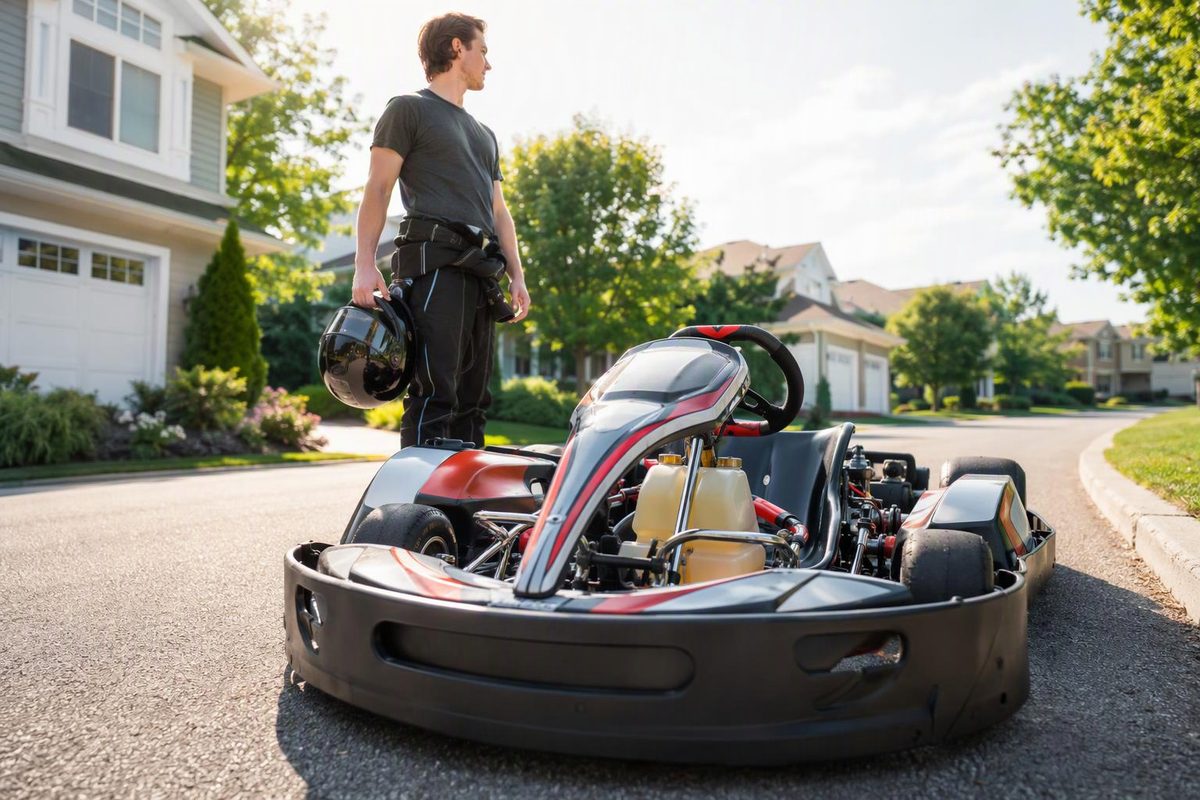
Do not assume a racing or recreational go-kart is street legal because it has lights or can stay below the speed limit. The first question is whether your state will register that exact vehicle in a class permitted on public roads—not which accessories you can bolt onto it.
For example, New York DMV explicitly prohibits registering or operating off-road go-karts in areas allowing public motor vehicle traffic. It separately allows qualifying, approved low-speed vehicles. Those are different categories, even when a seller uses “street-legal kart” loosely.
Rules below are current as of October 25, 2026. State and local permission must be checked for your vehicle and route.
A go-kart is not automatically a low-speed vehicle
The federal low-speed vehicle, or LSV, category is often relevant to small road-going vehicles. Under 49 CFR §571.3, an LSV is a motor vehicle that:
- Has four wheels.
- Attains more than 20 mph but no more than 25 mph over one mile on a paved, level surface.
- Has a gross vehicle weight rating below 3,000 pounds. GVWR is the manufacturer’s rated loaded weight, not simply the vehicle’s empty weight.
Matching those numbers is not enough: an LSV must also meet its applicable safety requirements. A kart that attains 40 mph in the prescribed test does not satisfy the LSV speed definition simply because its driver promises to stay below 25 mph. Nor does limiting an off-road kart to 20 mph establish road permission.
Treat a golf-cart conversion process as specific to golf carts, too. Florida’s published conversion procedure requires documentation, inspection and VIN assignment; it is not a blanket authorization to convert any racing kart.
Vehicle top speed and road speed limits are different
Two numbers commonly appear in LSV guidance:
| Number | What it means |
|---|---|
| 25 mph | The federal LSV maximum attainable speed under the prescribed test—not a universal go-kart road allowance. |
| 35 mph | A roadway’s posted limit used by some states to decide where LSVs may operate—not permission for an LSV to travel at 35 mph. |
For a concrete state example, Florida restricts LSV travel to streets posted at 35 mph or less, but allows crossing a higher-speed road at an intersection. The statute also allows local governments and the state transportation department to prohibit LSV operation on roads under their jurisdiction for safety.
Florida also requires title, registration, personal injury protection and property damage liability insurance, plus a valid driver license in the operator’s immediate possession.
Do not apply Florida’s rule nationwide. New York, for instance, requires a registrable LSV to meet FMVSS 500, have manufacturer-certified maximum performance speed and appear on its approved limited-use vehicle list. Its DMV offers a model-specific approval check.
Required LSV safety features
The federal FMVSS No. 500 equipment requirements include:
- Headlamps, front and rear turn signals, taillamps and stop lamps.
- Red reflex reflectors on each side as far toward the rear as practicable, plus one on the rear.
- A driver-side exterior mirror and either a passenger-side exterior mirror or an interior mirror.
- A parking brake.
- A windshield meeting the federal glazing standard.
- A VIN meeting federal identification requirements.
- A compliant seat-belt assembly at every designated seating position.
- Compliance with the specified rear-visibility requirements of FMVSS No. 111.
This is an LSV compliance list, not a DIY kart conversion recipe. A working lamp or generic belt is not necessarily a compliant installation. Likewise, a karting helmet is not a substitute for required road-vehicle equipment, certification or registration.
For a vehicle sold as an LSV, ask to see the manufacturer’s certification label. Federal labeling rules require information including the manufacturer, manufacture date, weight ratings, VIN, vehicle classification and conformity statement.
Before buying a “street-legal kart”
Use this order before paying for the vehicle or conversion parts:
- Identify it precisely. Obtain the make, model, VIN, origin or ownership documents, certification information and details of modifications.
- Ask your state DMV about that vehicle. Confirm its eligible road class and any inspection, title or approval requirements. Do not settle for “people register these.”
- Check the whole route. Ask the relevant road authority about permitted roads, local restrictions and crossings. One unsuitable segment can make the intended trip impractical.
- Confirm driver and insurance requirements. Get an insurance quote for the actual vehicle and intended road use.
Your checkpoint: can the DMV confirm the registration path, can you insure it as required, and is every part of the intended route permitted? If not, pause the purchase.
If your goal is progressing from rentals to an owned racing kart, separate that decision from road transport. Choose equipment around the circuit and class you intend to run; our guide to starting competitive kart racing explains that progression.