
Two-Stroke Kart Engine Maintenance: A Practical Owner’s Routine
Build a two-stroke kart maintenance routine for fuel mixing, pre-session checks, cleaning, service hours and storage—without guessing engine specifications.
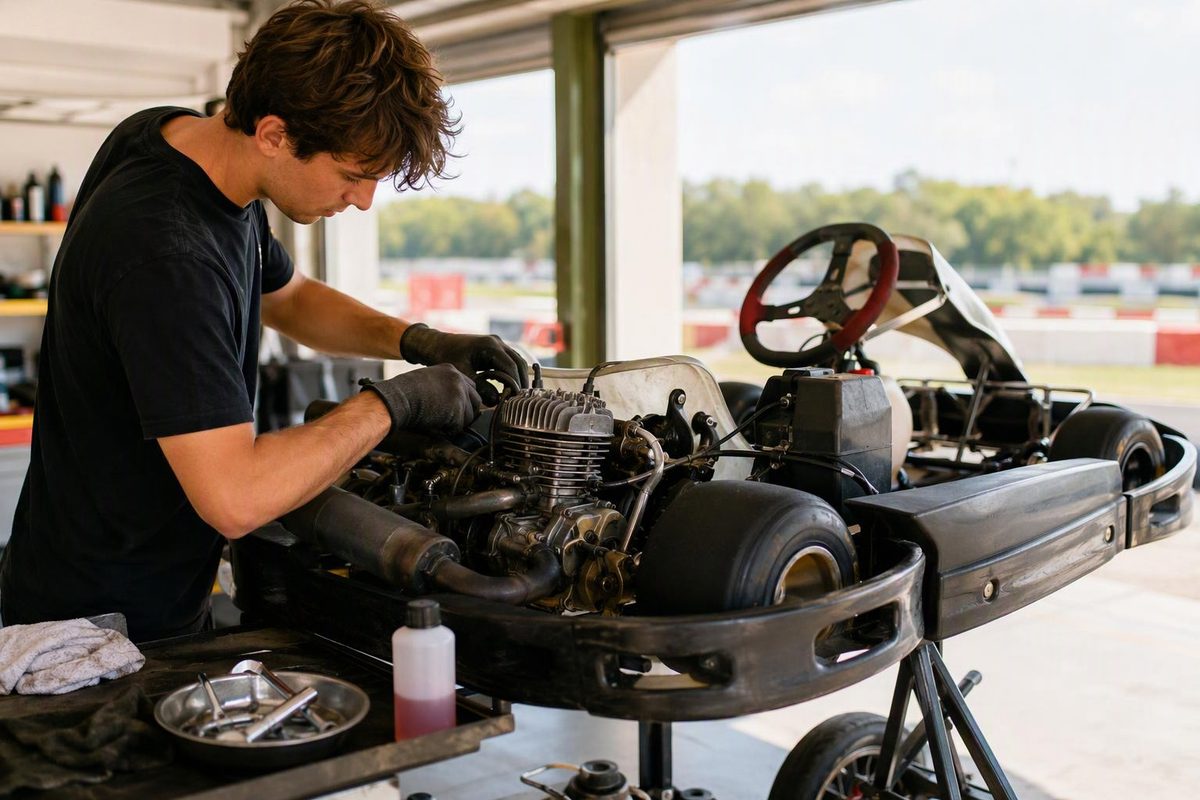
Maintain a two-stroke kart engine by using the specified fuel-and-oil mix, checking its intake, cooling and drive systems before running, cleaning and inspecting it afterwards, and recording engine hours for scheduled servicing.
The routine is transferable; the specifications are not. Oil ratio, spark plug, operating temperature, clutch servicing and rebuild intervals must come from the manual for your exact engine and version—not another driver’s kart.
If you’re moving from rentals to your first owner kart, start with these checks rather than learning engine rebuilding first. On rental or arrive-and-drive equipment, report faults to the operator instead of servicing it yourself.
Establish your engine’s maintenance baseline
Record the engine model and serial number, find its applicable operator manual, and ask the seller or engine service centre for its maintenance history. Before your first track day, write down:
- Fuel specification, approved two-stroke oil and normal mixing ratio.
- Any separate running-in instructions after a rebuild.
- Spark plug specification and installation torque.
- Operating temperature and RPM limits.
- Inspection and replacement intervals, measured in running hours.
- Any separate gear-compartment oil requirements.
Premix does not necessarily lubricate every system. For example, the Rotax MAX evo operator manual specifies both oil mixed into the fuel and separate balance-drive gearbox oil. Include its level checks and oil changes in your maintenance schedule where applicable.
If a used engine’s hours or rebuild history are unknown, arrange an inspection rather than assuming its service clock starts at zero. Before opening an engine used in competition, ask your club or service centre what work is permitted and whether seals must remain intact.
Mix fuel accurately
For premix engines, measure the petrol and oil separately in a suitable fuel container. Label it with the mixing date, oil and ratio, then mix thoroughly before filling the kart.
These two manual examples show why there is no universal “kart mix”:
| Engine/manual example | Normal-use petrol-to-oil ratio | Oil added to 5 litres of petrol |
|---|---|---|
| Rotax MAX evo, April 2024 operator manual | 50:1 | 100 ml |
| IAME KA100/REEDJET, MAN-072/C-USA installation manual | 20:1 | 250 ml |
The Rotax manual specifies 2% oil for normal use, while the IAME manual specifies 5% (20:1). These are examples, not specifications for every Rotax or IAME engine. Running-in can require a different mix.
Don’t add extra oil “for safety” or reduce it to chase speed. Rotax warns that insufficient oil can cause piston seizure and excess oil can cause deposits and ring sticking. It also advises keeping only the fuel quantity needed in the near future and shaking the container before each refuelling.
Mix and refuel in a well-ventilated area, away from ignition sources, with the engine stopped. Keep fuel off hot components and deal with spills before starting. These precautions and oil warnings appear in the Rotax manual’s fuel instructions.
Before each session: follow the same inspection order
Work with the engine stopped and cool enough to handle. Keep hands and clothing clear of the chain and axle whenever the engine is running.
- Fuel and intake: Look for leaking, damaged or loose fuel hoses. Inspect the filter for contamination. Check that the carburettor and airbox are secure and the intake is unobstructed. Check the air-filter element for dirt or damage; clean and oil it only as its manufacturer specifies.
- Throttle: Press and release the pedal. Confirm that the cable moves freely and the carburettor returns fully to its closed or idle position. A sticking throttle means no running until repaired.
- Cooling, where fitted: Check the level with the system cold, hose connections, radiator cleanliness and any external water-pump belt. Use the specified fluid rather than assuming road-car coolant is suitable.
- Chain and sprockets: Inspect tooth and chain wear, sprocket alignment, tension and lubrication. Use the applicable tension procedure, not a guessed universal slack measurement.
- Mounts, exhaust and electrics: Check engine-mount security, exhaust supports and springs, battery security, connectors, grounds and plug-cap fit. Use specified torque values where tightening is required.
The IAME KA100 maintenance schedule includes these drive, exhaust and electrical checks before use. Rotax additionally calls for cooling-system and fuel-filter inspections. Engine checks do not replace the kart’s brake, steering and tyre checks or the circuit’s safety requirements.
On track: warm it correctly, then watch for changes
Follow the prescribed warm-up; a running-in procedure after a rebuild is a separate task. Don’t demand full power from a cold engine.
For example, Rotax’s April 2024 MAX evo manual gives a recommended 45–85°C coolant operating range and warns against peak performance before operating temperature is reached. That range is not a target for other engines. Its running-in instructions also contain additional requirements. Use the applicable operating limits.
End the session safely, following the circuit’s stopping and exit procedures, if temperature exceeds the specified limit, a leak appears, the throttle sticks, or you hear a new metallic noise. Investigate before running again. Smoke or a burning smell around the clutch also warrants inspection: the IAME manual identifies these as signs of clutch overheating.
A hesitation at corner exit is an observation, not proof that the carburettor needs leaning. Note where it happened and check fuel delivery, intake condition and the established settings first. A lean setting supplies too little fuel relative to air; excessively lean carburettor settings can overheat and seize the engine. Keep tuning separate from routine maintenance; the kart carburettor guide covers setup and troubleshooting.
After running: clean, inspect and record
Once the kart has cooled:
- Clean the engine exterior so leaks and loose parts are easier to spot.
- Recheck chain and sprocket condition and lubricate as directed.
- Inspect the intake after dusty or wet running; Rotax specifically calls for air-filter servicing after rainy sessions.
- Switch off or disconnect the battery as instructed and charge it with the specified, battery-compatible charger.
- Record running time, symptoms and work completed.
The IAME maintenance schedule specifies external cleaning, chain lubrication and battery disconnection after use; Rotax covers wet-session filter care and its charger requirements.
Use a simple log: date; hours added; total hours; fuel mix; carburettor setting; temperature observations; maintenance performed; next service due. Count warm-up and practice running, not only races.
Copy the service intervals from your manual into that log. Don’t wait for a power drop before arranging scheduled piston, bearing, clutch or exhaust work. Internal measurements and crankshaft work belong with a suitably equipped specialist; Rotax requires its scheduled engine teardown inspection to be performed by an authorised service centre.
Prepare it for storage and transport
For an extended lay-up, follow the preservation procedure rather than leaving the kart as it finished its last session. Rotax specifies removing and draining the carburettor, closing its openings, sealing the engine intake and exhaust, protecting the exhaust against corrosion, and removing and periodically charging the battery. A water-filled cooling system must be completely drained before freezing storage.
Transport orientation matters too: Rotax requires carburettor fuel to be drained before vertical transport because it can otherwise flow into the crankcase. Its preservation and transport instructions cover both tasks.
Before returning to the track, remove preservation closures, restore fluids and connections, and repeat the pre-session inspection.