
Go-Kart Carburetors: Tune by Throttle Position, Not Guesswork
Learn what a go-kart carburetor does, which circuit affects each throttle range, and how to diagnose bogging without losing your baseline.
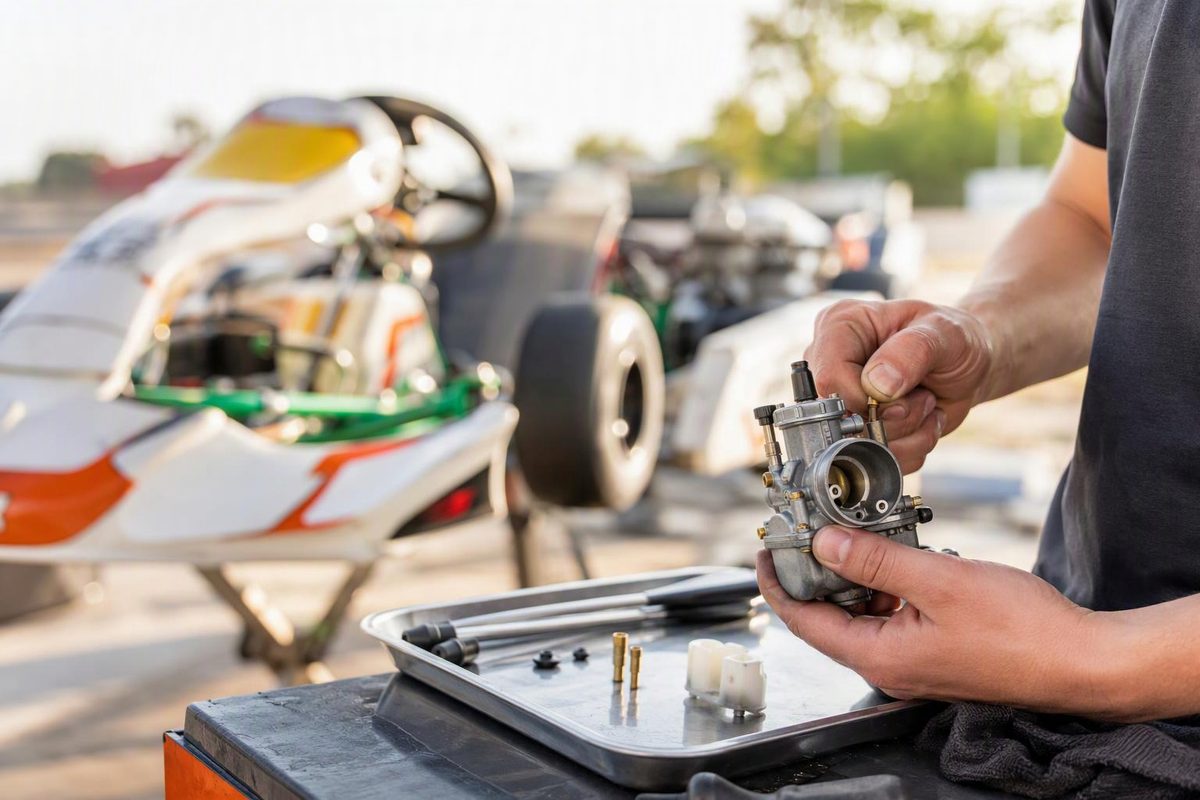
A go-kart carburetor meters fuel into the engine’s incoming air. The aim is not to make the mixture as lean as possible; it is to supply the mixture specified for the engine and conditions while remaining reliable and legal.
For a driver moving from rentals to an owner kart, the most useful principle is simple: identify when the problem occurs before adjusting anything. A hesitation as you first press the throttle does not point to the same circuit as a loss of power near the end of a straight.
Identify the carburetor and check the rules
Do not copy settings from a different engine package. Two common designs are:
- Float-bowl slide carburetors, in which a float and inlet needle maintain fuel in a bowl. Examples include the PZ carburetor used on a Briggs 206 and the Dell’Orto VHSB 34 used on current Rotax MAX engines (Rotax operator’s manual).
- Diaphragm carburetors, which use pump and metering diaphragms rather than a float bowl. Some have externally adjustable low- and high-speed needles.
The engine manual provides operating guidance; the current class rules define what may actually be changed. Those are separate questions. For example, the 2026 Briggs 206 rules require the stock carburetor, idle jet and main jet, but permit all five factory positions for the jet-needle clip and adjustment of float height by bending its tab. The rules also state that they take precedence over conflicting Briggs literature, manuals or videos (Briggs & Stratton 2026 rules). An adjustment allowed in one class can be illegal in another.
Before working, record:
- engine and carburetor model;
- current jet, needle or screw positions;
- fuel and oil mixture, where applicable;
- air temperature and session time;
- gearing and representative lap times.
That record is your return path when an experiment makes the kart worse.
Establish a safe mechanical baseline
Perform carburetor work in the paddock with the engine stopped and cool, away from ignition sources. Catch and dispose of drained fuel correctly. Inspect fuel lines, connections, gaskets and seals before running.
Then check the throttle mechanically. With the engine off, remove the air filter if the manual permits and observe the slide or butterfly while an assistant presses and releases the pedal. It should reach full opening at the pedal stop and return freely to fully closed. The Briggs carburetor guide warns that an open or sticking slide can let the engine start at high throttle. It calls for the correct carburetor return spring and an additional pedal spring where needed (Briggs carburetor guide). Refit the filter before running.
Also check for:
- a dirty or incorrectly prepared air filter;
- restricted tank venting;
- kinked, cracked or loose fuel lines;
- debris in the fuel system;
- loose carburetor or inlet-manifold fasteners;
- overflowing fuel;
- a float setting disturbed during transport.
These faults can imitate bad calibration. The Briggs guide notes that dirt can block a jet or hold the inlet needle open, while loose mountings or leaking gaskets and seals can create a lean condition. Briggs also recommends a fuel filter because debris can obstruct a jet or fuel delivery (Briggs preventative guide). Use only the filter type and location allowed by your rules.
Match the symptom to the throttle range
Think in throttle position, not simply engine rpm. For a typical slide carburetor, begin your checks here:
| Where the symptom appears | First area to investigate |
|---|---|
| Closed throttle, idle or initial pickup | Idle circuit, pilot jet or mixture adjustment |
| Part throttle through corner exit | Jet needle and needle position |
| Half to full throttle, especially down a straight | Main jet and fuel supply |
| Long corner, bumps or direction-specific cut-out | Float level, fuel pickup or delivery |
The ranges overlap. For its PZ design, Briggs identifies the jet needle as the main influence from roughly 10% to 75% throttle and the main jet as the main influence from half to full throttle (Briggs carburetor guide). That is model-specific guidance, not a universal map for every carburetor.
A rich mixture has excess fuel for the available air. On the Briggs PZ, listed clues include a dull or flat response, black exhaust smoke, or running worse as the engine warms. A lean mixture has excess air for the fuel supplied; listed clues include surging, cutting out, high operating temperature, or improvement with partial choke. None is conclusive alone. An air leak, blocked jet or failing fuel supply can produce similar symptoms.
Stop if the engine temperature rises abnormally, it begins rattling under load or power changes sharply. Do not keep circulating to get one more reading. The Briggs guide warns that an improper main jet can cause power loss, high temperature or engine damage.
Change one variable at a time
Begin from the manufacturer’s legal baseline and test with the engine at its specified operating temperature:
- Drive repeatable laps. Use the same braking marker, entry speed, line and throttle application. If your exits vary, carburetor comparisons are unreliable. Our guide to kart racing lines explains how to hold those decisions steady.
- Name the symptom precisely. Record the corner, approximate throttle opening and engine behaviour: “clean initial pickup, then stutters at half throttle” is more useful than “slow off the corner.”
- Check mechanical causes first. Inspect the throttle, fuel supply, filter and mountings before changing calibration.
- Change one legal adjustment. Do not alter a needle position, mixture screw and gearing together.
- Test under comparable conditions. Compare several representative laps, not one peak lap affected by traffic or a mistake.
- Keep or reject the change. Record the result and return to baseline if the evidence is unclear.
With an adjustable diaphragm carburetor, establish and mark a known “home” position. Tillotson recommends changing only one needle at a time, making small adjustments and testing richer first rather than leaning the engine in search of performance (Tillotson maintenance and tuning guide). Never force an adjustment needle against its seat; the same guide warns that this can enlarge the metering orifice and change the calibration.
Separate driving from carburetion
A bog on exit is not automatically a carburetor fault. If it appears only when you use full throttle early in one tight corner, repeat that corner with a later, smoother application while leaving the kart unchanged. A clean response may indicate that pedal timing or low engine speed—not carburetor calibration—is the first issue to address.
If the fault instead repeats at the same throttle position in several corners and on a straight, fuel metering or delivery becomes a stronger suspect.
Use this checkpoint before reaching for a tool: same line, same pedal application, same symptom. Tune only after you can reproduce that pattern. It protects the engine, preserves your baseline and turns carburetor work into a controlled test.