
How to Choose a Kart Racing Helmet for Rentals and Club Racing
Choose a kart racing helmet by checking event approval, fit, visor visibility and condition before spending on graphics or extras.
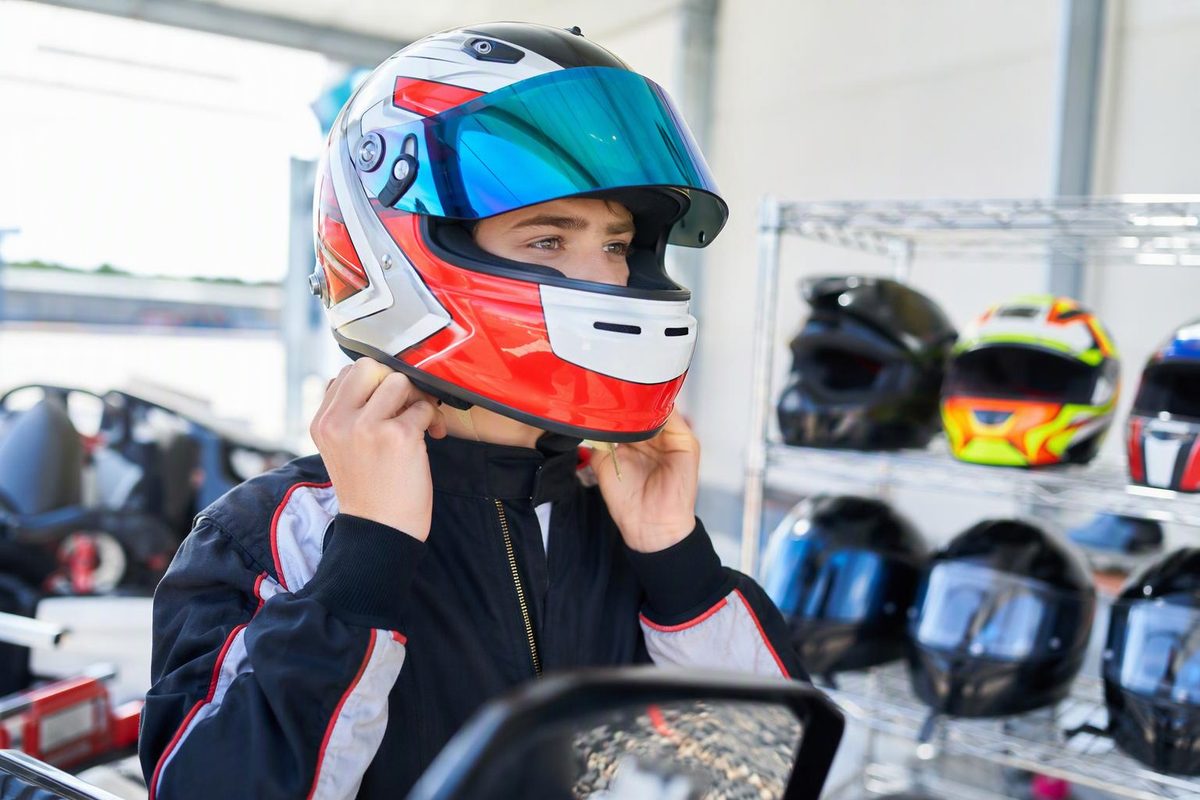
Choose a kart racing helmet in this order: check the rules, find a secure fit, then compare visibility, comfort and price. Start with where you race now—and the club or championship you intend to enter next. A helmet accepted for rental sessions is not automatically eligible for club racing.
Check approval before shopping
Ask your circuit or organiser which helmet standards it accepts for your age and class. Get the full standard designation, including its year, and ask whether an inspection sticker or other approval is required.
The letters on a helmet label describe different intended uses. Snell’s standards list distinguishes:
| Marking | Intended use |
|---|---|
| K, such as K2020 or K2025 | Kart racing |
| SA, such as SA2020 or SA2025 | Competitive automotive sports |
| M, such as M2025D or M2025R | Motorcycling |
| Snell/FIA CM, including CMR/CMS markings | Children’s motorsports |
This is a label guide, not a universal acceptance list. Do not assume that “Snell approved” without the specific designation is enough.
For example, as checked on 24 October 2026, K1 Speed’s US FAQ permits personal helmets that are DOT-approved, full-face and equipped with a visor or goggles. That is the operator’s policy—not a club-racing rule.
By contrast, Motorsport UK’s 2026 National Competition Rules, Edition 5, have age-specific requirements. For kart drivers under 15, and Cadet and Bambino drivers, they list Snell/FIA CMR2007, CMS2007, CMR2016 or CMS2016 and a maximum helmet weight of 1,550 g, subject to any revised limit specified in the rules. They also require an ASN (national sporting authority) approval sticker as part of the approval procedure. These are Motorsport UK national competition requirements, checked on 24 October 2026—not worldwide rules. International events follow FIA regulations.
If you want one helmet for rentals and future competition, confirm that the exact approval works for both before paying. If the future series is undecided, use the venue’s supplied equipment, where available, while you investigate rather than guessing.
For a Snell-certified helmet, check the certification label inside—often beneath the comfort padding—not just a logo on the shell. Snell explains how to identify its labels.
Fit the helmet, not just the size chart
Measure your head according to the manufacturer’s instructions, then try several eligible models. Size labels vary between manufacturers, and two drivers with the same head circumference can need different helmet shapes. Snell recommends a fit that is snug around the crown and does not shift on the head.
Use these checks before buying:
- Wear your usual balaclava and glasses, if applicable. Check the combination you will actually race in.
- Fasten the chin strap correctly and snugly. Follow the helmet’s instructions; fastening the loose end alone is not enough.
- Check movement. The helmet should not slide independently from side to side.
- Check retention. With your head forward and strap secured, try pulling the rear of the helmet upward. It must not roll off.
- Leave it on for five to ten minutes. Look for persistent pressure or discomfort, rather than judging it after a few seconds.
The movement and retention checks follow Motorsport UK’s fitting guidance; the trial-wear interval comes from Snell’s fitting advice. Ask an experienced helmet retailer to help if you are unsure.
Do not choose a loose helmet for comfort or buy an oversized junior helmet to “grow into.” Try another shape instead.
Check visibility before adding extras
With the helmet fastened, check that you can see clearly over each shoulder, breathe unobstructed and open the visor with one gloved hand—checks also specified in Motorsport UK’s guidance.
Choose a visor suitable for the lighting you actually encounter. Before driving, check it for dirt, scratches or fogging that obstructs your view. Resolve visibility problems before joining the track.
Spend on an eligible, well-fitting helmet before graphics. Price alone does not establish protective capacity, as Snell notes. Snell also warns that aftermarket accessories can invalidate certification. Confirm both manufacturer instructions and event rules before fitting cameras, spoilers or other accessories.
Inspect it before every session
Check the shell, strap, buckle, visor and interior for damage or deterioration. Follow the manufacturer’s cleaning and storage instructions.
Replace a helmet after an impact while it is being worn, even if the outside looks acceptable. Snell explains that the impact liner can be damaged and unable to provide adequate protection again. It also recommends replacement after five years of normal use; that recommendation is separate from an organiser’s acceptance dates for a particular standard. See Snell’s impact and replacement guidance.
The pre-session checkpoint is straightforward: accepted approval, secure fit, fastened strap and clear vision. Once those are settled, keep equipment choice separate from driving practice. Use repeatable cornering drills to work on braking, turn-in and exit—not a helmet purchase as a lap-time upgrade.